The State of Play: Generative AI Litigation Market Overview, 1 January 2026


Peter Wedge FCII, Martim Cruz, George Lewin-Smith, Mark Titmarsh and Alec DewitzPublished January 1st, 2026 · Updated September 17, 2026
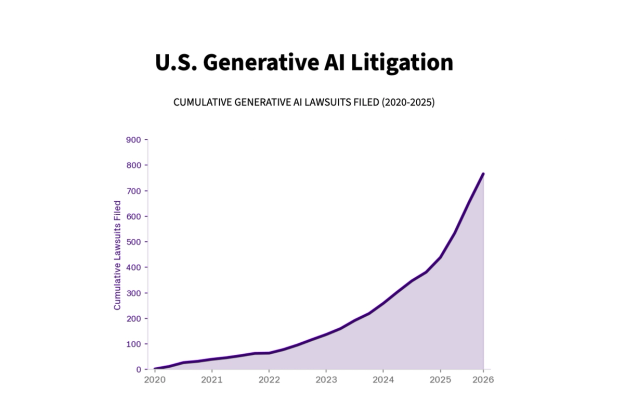
As of January 1, 2026, US generative AI lawsuit filings are up 137% year-over-year, with $5 million the median demand and 32% filed as class actions. Testudo's State of Play litigation report maps the claims landscape and explains why enterprises need standalone Gen AI liability insurance.
Federal and state generative AI-related lawsuits are one type of high quality signal for real world AI risk. The number of GenAI filings increased 137% in 2025, an alarming signal that litigation is rising exponentially as AI usage expands, according to a new report released today by Testudo. As AI deployments proliferate across enterprises in the U.S. and insurance coverage is pulled back by insurers, "when it comes to AI liability risk, putting your head in the sand and hoping it goes away isn't a plan" (George Lewin-Smith). For the latest on how AI vendors are shifting liability to deployers, see the Q1 2026 AI insurance market update.
The State of Play: Generative AI Litigation Market Overview, 1 January 2026
The State of Play is from the dedicated research lab of Testudo Global, Inc., where we use data insights from real world AI risk underwriting and pricing to provide market commentary. Email us to request it!
Key Findings
- Generative AI lawsuit filings are up 137% in 2025 and rising
- As AI usage expands across the U.S. economy, litigation is increasing exponentially.
- Model hallucinations define only 4.9% of generative AI lawsuits.
- A very small number of U.S. generative AI lawsuits involve claims related to AI ‘hallucinations’, which are instances where AI systems generate false or misleading information that causes harm. This highlights that the performance of an AI model has limited impact on a firm's AI liability exposure.
- 32% of generative AI lawsuits are class actions
- One third of generative AI lawsuits are class actions. Class actions represent a particularly acute source of aggregate exposure for defendants, as they concentrate large numbers of similarly situated claimants into a single proceeding, amplifying damages, defense costs, and settlement pressure.
- $5M is the median demand amount for an AI lawsuit
- While 70% of cases seek less than $10M, approximately 16% involve demands exceeding $100M.
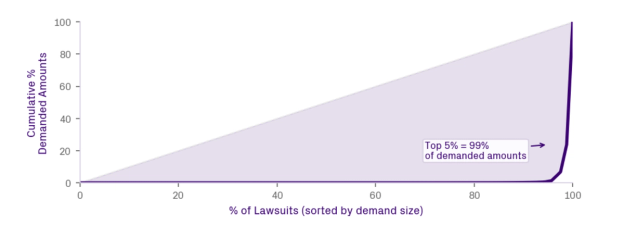
- There is an extreme loss concentration for AI lawsuits
- The top 5% of cases account for 99% of total demanded amounts. Of course, demands are not settlements.
- Over 32% of publicly traded U.S. companies are using AI
- Generative AI liability risk is real, increasing, causing damages and sitting silently on the balance sheets of enterprises that passively deploy generative AI.
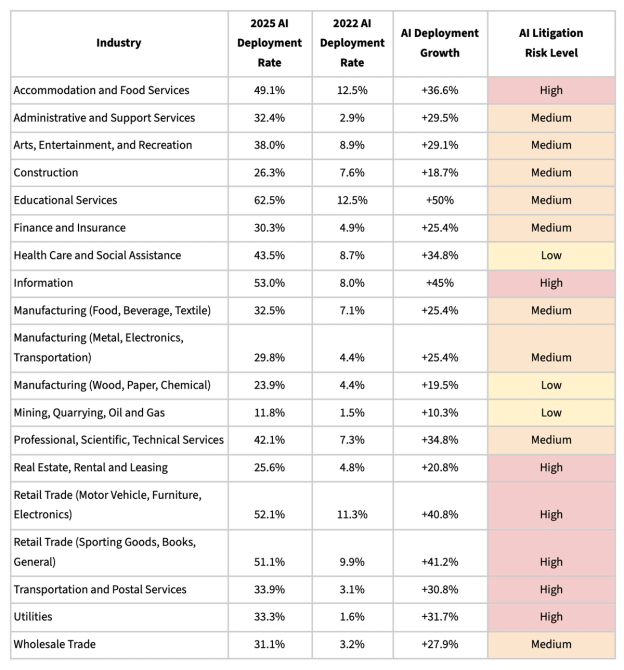
- AI deployment rates and litigation risk by industry
- Below is an overview of AI deployment rates per industry (NAICS codes) and a view of AI litigation risk per industry based on our data.
- Bonus: 2026 is the year of the Agent
- AI agents materially increase risk exposure because they can act autonomously and execute at scale. While human-in-the-loop review and other braking mechanisms can reduce the likelihood of serious harm, they constrain system speed and autonomy, undermining the efficiency gains that drive adoption.
How many generative AI lawsuits were filed in the US in 2025?
Generative AI lawsuit filings in the US increased 137% in 2025, according to Testudo's State of Play litigation report. The growth is exponential as AI deployments expand across industries and traditional insurers retreat from coverage. Enterprises without standalone generative AI liability insurance face direct balance-sheet exposure to these rising claims.
What types of claims drive generative AI lawsuits?
Despite media focus on hallucinations, model hallucinations define only 4.9% of generative AI lawsuits. The bigger drivers are intellectual property infringement, defamation, financial loss from AI outputs, and unauthorized data disclosure. One third of all generative AI suits are class actions, which concentrate exposure and amplify settlement pressure. The top 5% of cases account for 99% of total demanded amounts, with $5 million as the median demand.
What insurance covers generative AI liability?
Standard CGL, Cyber, and Tech E&O policies increasingly exclude generative AI losses, as detailed in The Great AI Insurance Coverage Gap. Testudo's standalone Gen AI liability insurance, on Lloyd's of London paper rated A+ (Superior) by AM Best, is purpose-built to respond to the third-party claims documented in this litigation data: IP infringement, financial loss, defamation, data disclosure, and physical harm.
About the authors

Peter Wedge FCII
General Counsel
General Counsel with 40+ years of insurance experience across specialist wordings, claims management and contract counsel. Previously Director of Cyber Wordings at Gallagher Re in addition to chairing the Cyber Insurance Association and the Reinsurance Wordings Expert Forum and holding committee positions across BIBA, the IUA, AIDA Europe, and the Insurance Institute of London.

Martim Cruz
Founding Member of Technical Staff, Data
Previously led Quantitative Research and Data for Goldman Sachs' Digital Assets team, working on quantitative modeling, pricing and structuring across intraday foreign exchange and interest-rate structures, as well as new options-based products. Before Goldman, he worked at a quantitative hedge fund while completing his MSc.

George Lewin-Smith
CEO | Co-Founder
Previously a VP at Goldman Sachs in the Global Banking and Markets division, operating across SF and London (capital markets and enterprise adoption of emerging technology). Two years startup experience and self taught software engineer after the University of Oxford. FCA/Finra/CA P&C regulated.

Mark Titmarsh
Head of Insurance | Co-Founder
Insurance and risk strategist with 15+ years shaping how the industry underwrites emerging technology. A specialist in generative AI, digital asset custody, financial lines, and product innovation, with a track record of building first-of-their-kind offerings for firms including Superscript, Malca-Amit, and Aviva. Known for turning complex, frontier risks into insurable, market-ready products.

Alec Dewitz
CTO
Previously Lead Member of Technical Staff at Salesforce in San Francisco building AI systems and deploying agents for Fortune 500 enterprises. More than a decade of experience across startups and generative AI products.